Adhesion Systems: The Future of Edgebanding
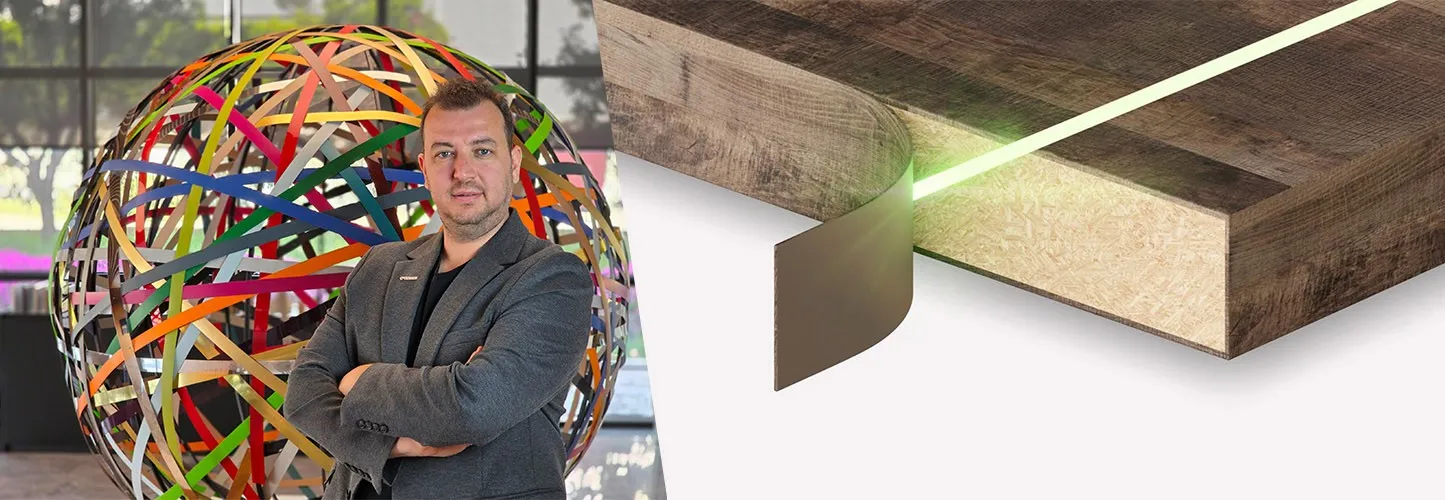
When a piece of edgebanding fails, the customer usually blames the tape or the machine. One of them, they assume, must be at fault.
Ertuğ disagrees. And after years leading R&D at TECE, he has seen enough delamination cases to know that the answer is almost never that simple.
In Part II of our interview series, TECE's R&D Manager returns to talk through bonding methods in detail — the difference between EVA, PUR, and glue-free systems, the process parameters that actually determine adhesion quality, and what his team looks for when a failure lands on their desk. He also addresses one of the most common complaints in the industry: the same product, different results, different machines.
If you missed Part I — covering raw material quality, Zero-Line technology, color matching, and practical application tips — it is available on the TECE YouTube channel.
Glue-Free Systems: The Same Principle, Different Entry Points
The conversation opens where Part I left off: bonding methods. EVA and PUR have their place, but glue-free systems are the technology the European furniture industry has already moved toward — and the rest of the market is following.
Laser, near-infrared, and hot air systems all work on the same underlying principle. Understanding that principle matters before choosing between them.
"Instead of external glue, you use energy to activate the co-extruded functional layer on the back of the edgebanding. Since there is no external glue line, a polymer-to-polymer interface fusion occurs — and the result is a visually flawless, invisible joint. Since there is no glue pot, there are no limitations such as open time."
— Ertuğ, R&D Manager, TECE
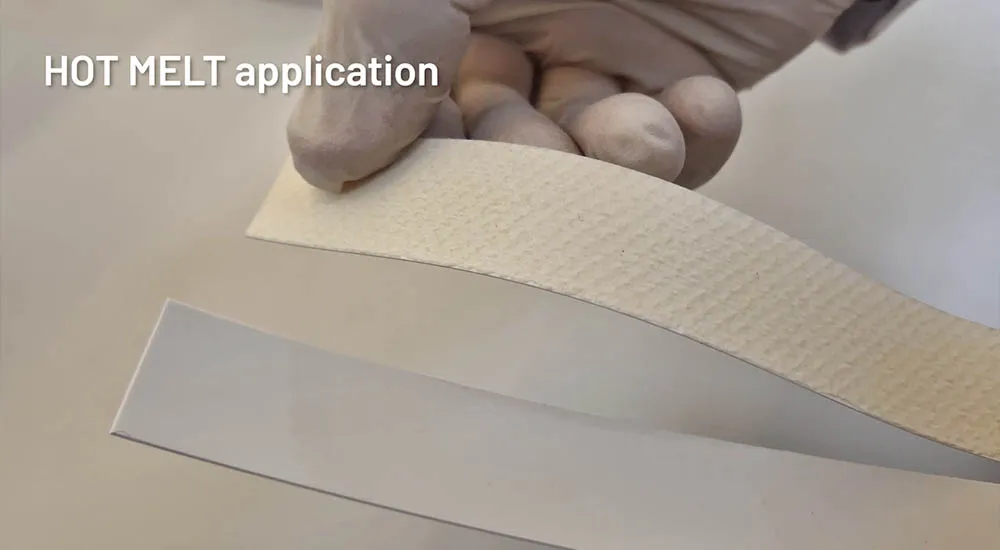
The aesthetic result is the clearest advantage: no glue line visible at the joint. For high-end furniture — kitchens, fitted wardrobes, commercial interiors — that invisibility is no longer a luxury specification. It is an expectation.
Laser and near-infrared systems deliver that result at high line speeds, but they carry a significant initial investment. Hot air offers a more accessible entry point into the glue-free category — Zero-Line compatible, no consumables — with the trade-off of lower throughput. And then there is plasma, a method Ertuğ highlights for a specific application:
"Plasma works perfectly, especially for polypropylene edgebanding — and it is an eco-friendly method. What is critical is increasing the surface energy and obtaining an active surface suitable for bonding."
— Ertuğ, R&D Manager, TECE
The Parameters That Actually Determine Quality
Whatever bonding system a manufacturer uses, the outcome depends on more than the material itself. Ertuğ is precise on this point: there is no single parameter that determines bonding quality. There are five — and they only work when they work together.
"It depends on the combination of temperature, pressing pressure, line speed, surface quality, and the back layer structure of the edgebanding. For example, if the temperature is not sufficient, activation isn't completed — and if it is too high, deformations may occur in the material structure."
— Ertuğ, R&D Manager, TECE
The same logic applies to pressure. Too low, and the bond surface doesn't seat properly. Too high, and the surface form is distorted. Every parameter has a range — and operating outside it produces problems regardless of how good the edgebanding is.
"We do not just check if it stuck or not. We evaluate the entire process. Because even the best product will not perform as expected at the wrong temperature, wrong pressure, or unsuitable line speed. A strong result is achieved as much by proper setting discipline as it is by the right material."
— Ertuğ, R&D Manager, TECE
When It Fails: Reading a Delamination Case
This is where the interview becomes most instructive. When customers come to TECE with a bonding problem, Ertuğ's team does not start by looking at the edgebanding. They start by asking when the failure occurred.
"Every delamination case has its own unique story. First, we determine: at what stage does the problem occur? If it happens immediately — meaning the tape opens as soon as it leaves the machine — this usually means insufficient pressure or low temperature."
— Ertuğ, R&D Manager, TECE
Immediate failure points to process. But delayed failure — the kind that surfaces days later, after the product has reached the customer — tells a different story entirely.
"If the problem appears after a few days — especially after the customer receives the product — then it is different. We usually see chipboard or MDF surface contamination, moisture issues, or wrong glue selection. Banding MDF panels right after production is a classic mistake. The moisture inside the MDF has not yet stabilized. The glue seems to stick, but a week later the panel shrinks and the tape peels off."
— Ertuğ, R&D Manager, TECE
Surface dust is another common culprit — one that many manufacturers underestimate. Panels coming straight from CNC cutting carry chip and dust residue that directly compromises adhesion. The fix is often as simple as a vacuum pass before banding. Not a material change. Not a machine adjustment. A cleaning step.
The broader principle Ertuğ returns to throughout the failure analysis section is one that applies to every bonding problem, regardless of cause:
"Adhesion is a system. The edgebanding, the glue, the machine settings, the panel quality, and even the ambient temperature — they all have to work together. If one fails, the chain breaks. That is why you must look at problem-solving systematically."
— Ertuğ, R&D Manager, TECE
Why the Same Product Performs Differently on Different Machines
One of the most common frustrations in the industry: a product that works perfectly on one line produces inconsistent results on another. Customers assume something is wrong with the edgebanding. Ertuğ explains why that assumption is almost always wrong.
"This is quite common and usually depends more on process conditions than the product itself. Each machine has different heat transfer, pressure, preheating capacity, and working tolerance. A product that works well on one line may not perform the same on another — because the application dynamics change."
— Ertuğ, R&D Manager, TECE
This is precisely why TECE's R&D team tests across multiple lines — not under one ideal set of conditions, but under the range of real conditions that exist on production floors across different operations.
"Our goal is to optimize the product not for one ideal condition, but for real field conditions. This way, whatever machine the customer uses, they get a more stable and predictable result."
— Ertuğ, R&D Manager, TECE
How to Choose the Right Product
When it comes to product selection, Ertuğ's advice is direct: start with your machine, not the material.
"The most critical point is choosing a product according to your machine. Every bonding method has a different dynamic. EVA, PUR, or Zero-Line — all require different backing and thickness structures. Each method has its own surface chemistry. That is why sharing the correct machine type when placing an order is essential. When the right product is combined with the right process, quality comes naturally."
— Ertuğ, R&D Manager, TECE
Where the Technology Is Going
The final question in the interview is the broadest: where is edgebanding technology headed? Ertuğ's answer is unambiguous on direction, and honest about what it means for manufacturers at different stages.
"Absolutely, glue-free systems will become more common. Environmental pressure is increasing, and consumers are demanding higher-quality, more durable products. Our role is to support our customers through this transition — both traditional workshops using EVA hot melt and large factories investing in state-of-the-art laser systems. The future will belong to lower-emission, sustainable, and functional polymers."
— Ertuğ, R&D Manager, TECE
Not every manufacturer is ready to move to glue-free today. The investment threshold is real, and the transition requires process recalibration across the line. But the direction is set — and TECE's R&D center is already working to ensure that both ends of the market have access to materials optimized for where they are now and where they are going.
To discuss which bonding system and edgebanding specification is right for your operation, get in touch with the TECE team.