


BLOG
Fake Products isn't a Solution, a New Problem.
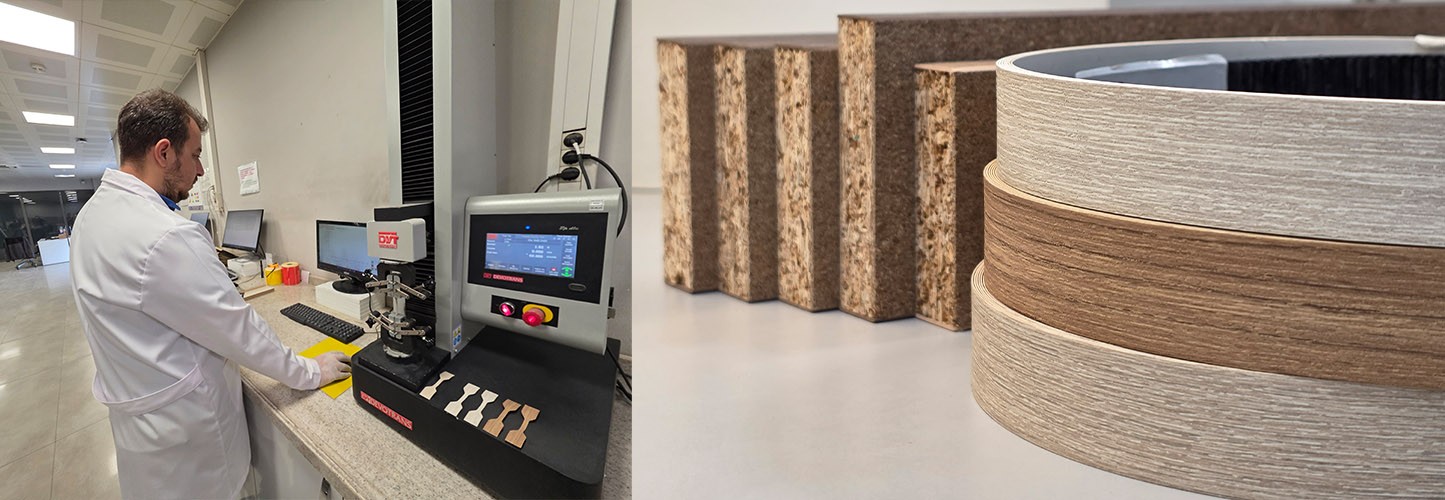
WHEN WE SEE OUR OWN CODE ON ANOTHER PRODUCT: HOW TO SPOT AN IMITATION?
A color can be copied. Even a code can be copied. But it is impossible to imitate quality. Appearance can be copied, quality cannot...As in every business, copies of products can appear in the edgebanding industry. A sample that came into our hands in recent weeks reminded us of this reality once again. While examining a sample set from a East Asian supplier, we saw our own TECE code on the back of one of the products. The color had been imitated; this is a situation we encounter from time to time in the industry. But the fact that the code was also copied exactly showed that the matter had gone further than we thought.
"Is this product really as high-quality as TECE?" It is not always easy to answer at first glance. Today, colors, patterns, and surface effects can be imitated to a significant extent. However, when it comes to the performance, durability, and long-term behavior of the product, the differences begin to emerge. It is possible to fake the appearance of a product; but it is much more difficult to fake the formulation, production know-how, and quality consistency that make it up. Indeed, the ways to distinguish the original from the imitation lie precisely in measuring these differences.
Visual Control
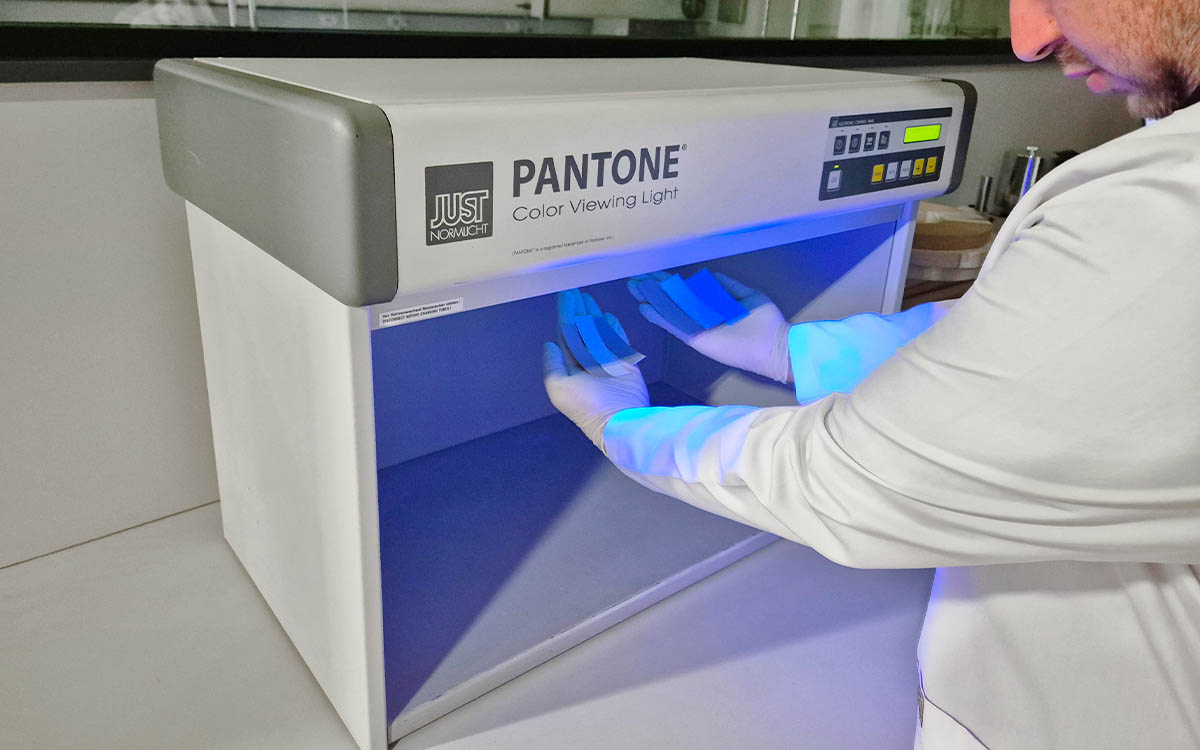
The first point of control is usually color. This was also the case with the sample in question: when we put our own original product side-by-side with the copy, they looked very similar under showroom light (TL84). However, when we examined the same samples under daylight (D65), the difference was immediately apparent. This is due to a phenomenon called metamerism: the imitation manufacturer achieves the same appearance using different pigment combinations, so the products only match under specific lighting. Apart from color, the depth of the emboss pattern, surface gloss, and printing precision are also examined. In imitations, the print is often blurrier and the pattern transitions are coarser; we saw this difference clearly in the sample we examined.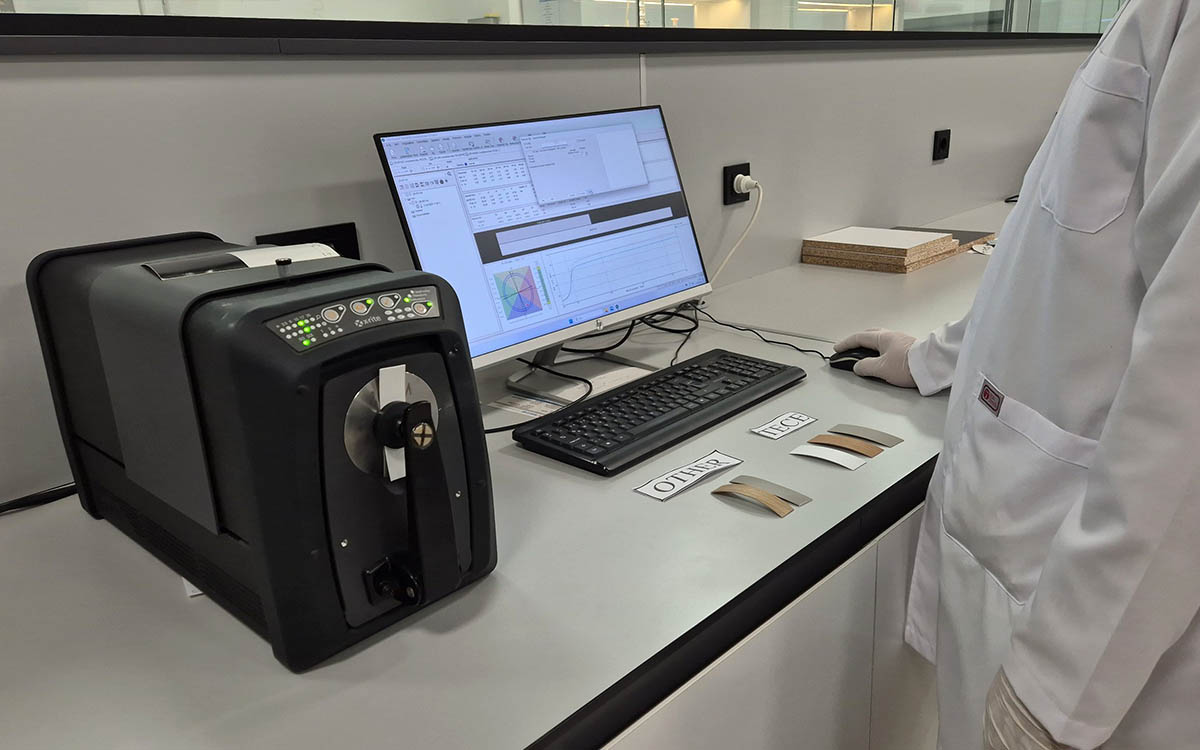
Dimensional and Mechanical Control
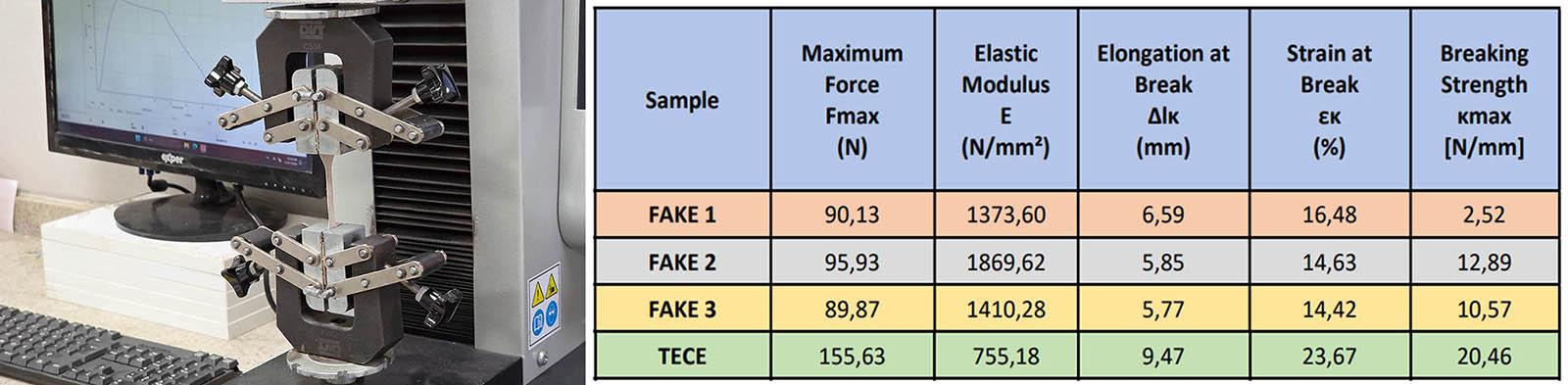
The second stage consists of physical measurements. Thickness tolerance, width consistency, and edge-cutting quality are compared; imitations are generally produced with wider tolerances and less consistency. Then come the mechanical tests: adhesion/peel strength, Shore hardness, and elongation at break are measured. Due to cost pressures, the raw materials and production parameters used in imitation products are often not at the level of the original product. When we tested the sample in question, the result pointed in the same direction: although visually similar to the original, it did not reach the same level in terms of mechanical strength and long-term usage characteristics.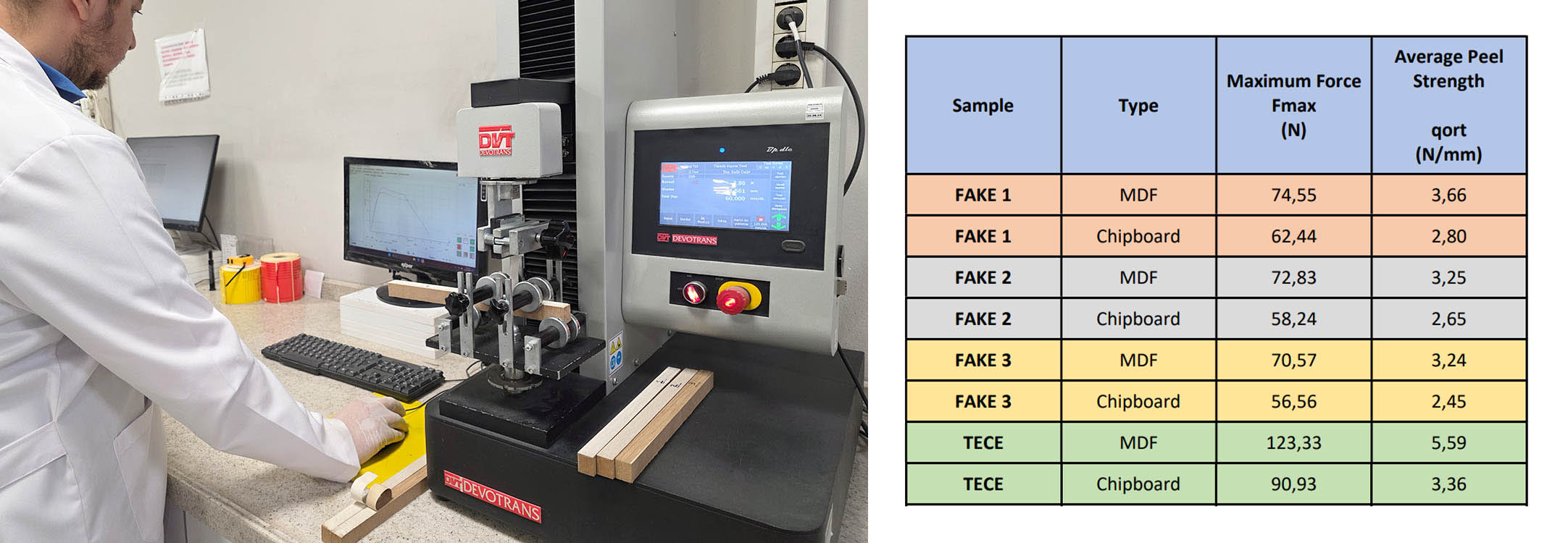
Functional Layer and Color Fastness
For products intended for pre-glued and glue-free systems (laser, hot air), there is an additional check: the quality of the primer coating or functional layer on the back, and the activation behavior of the band under actual machine conditions. In imitation products, this layer is often inadequate, resulting in poor adhesion in the machine. Another determining test is light fastness; imitation products fade visibly over time, especially in applications exposed to sunlight.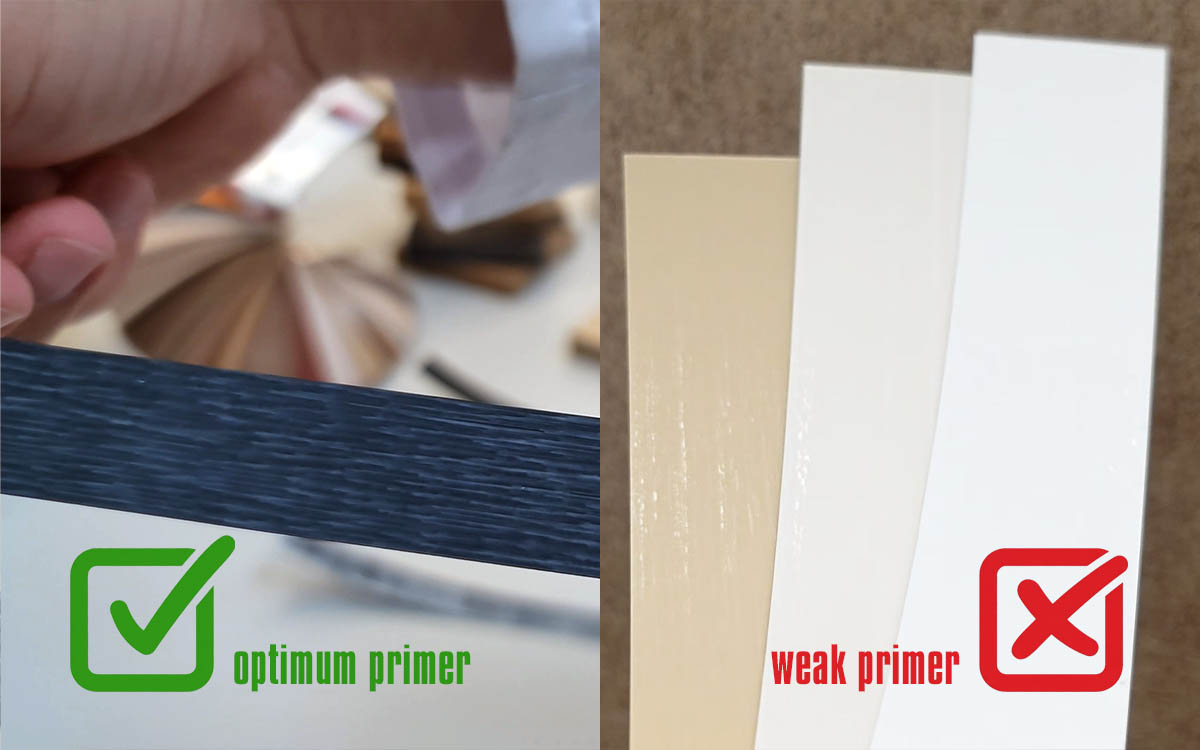
The Last Word from the Lab
Although visual and mechanical checks provide important clues, the clearest answers come from laboratory analyses. We also sent the sample we mentioned to the laboratory. FTIR analysis revealed the chemical structure of the material, DSC and TGA tests made the formulation differences visible, and Lab* and ΔE measurements numerically demonstrated differences that are hard to perceive with the naked eye. These measurements proved once again how different two products actually are, even if they look similar to the eye.Attractive Price, Expensive Result
Perhaps the most appealing aspect of imitation products is their price. At first glance, it looks really attractive. But there is an important thing to remember here: a piece of furniture is not a toy that you play with for a few months or a few days and then put aside. Furniture is manufactured to be used for an average of five years, and ten years in the kitchen. Throughout this period, the edgebanding must perform its duty every day on a cabinet door that opens and closes daily, on the edge of a countertop that is wiped every day, and in front of a sunlit window. A cheap imitation might get through the first few months without any problems. But the difference that emerges at the end of five or ten years—faded colors, peeling edges, cracked surfaces—has long since made that initial small price advantage meaningless.In conclusion, the true quality of a product is revealed not just in its appearance, but in its performance over time. The practical advice for the customer is clear: request samples, test the product under real usage conditions, and check certificates and restricted substance declarations. Because the quality of a product is hidden not in a single sample, but in its ability to remain the same across thousands of meters and at the end of many years.
If you ever suspect whether a sample you received really belongs to TECE, contact us. Let's make the evaluation together.


